
Grow buckwheat as a cover crop when you need a fast summer blanket on a bare bed. Cut the stand seven to ten days after the first flowers open, before the seeds harden and turn brown.
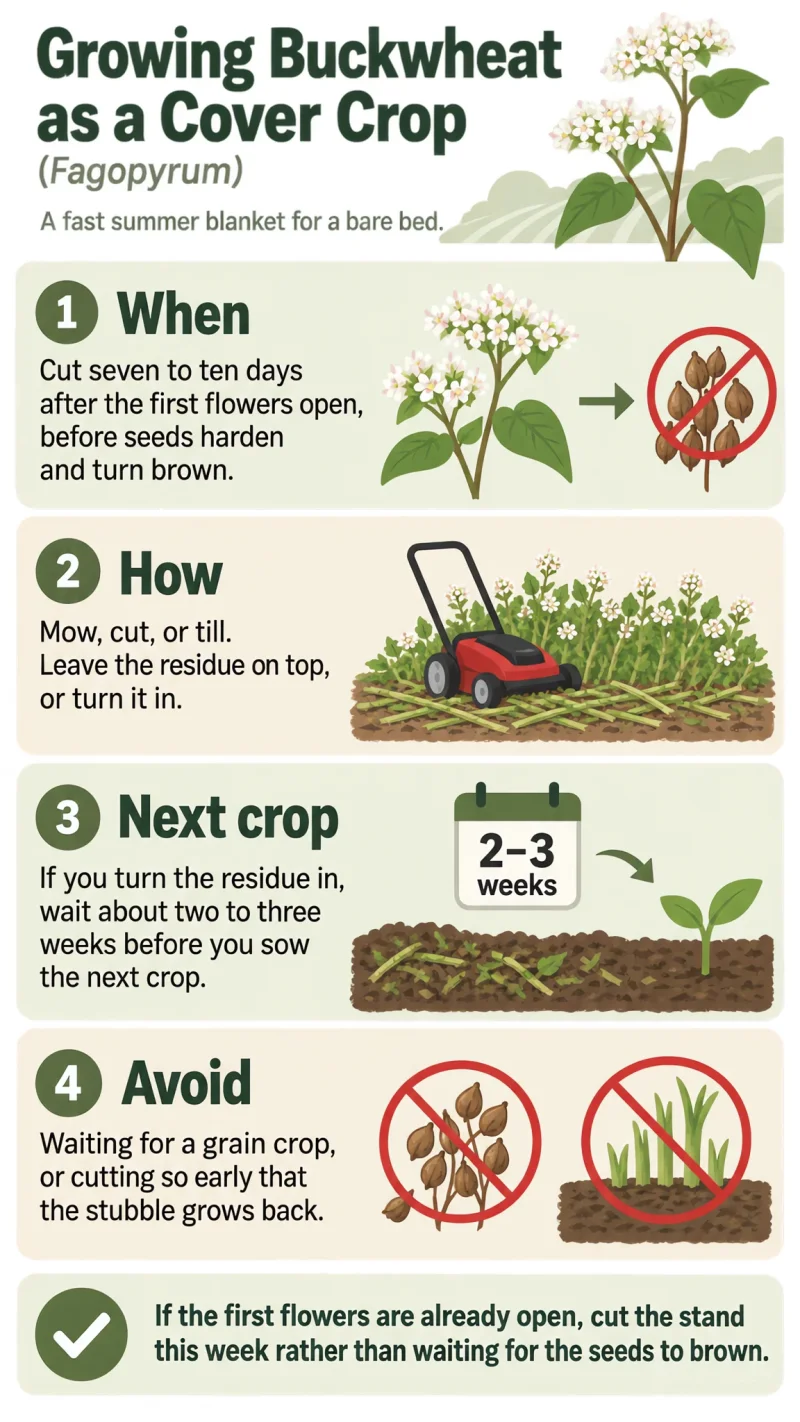
Cut the stand seven to ten days after the first flowers open
| Factor | Recommended | Avoid |
|---|---|---|
| When | Cut seven to ten days after the first flowers open, before seeds harden and turn brown | Waiting for a grain crop, or cutting so early that the stubble grows back |
| How | Mow, cut, or till. Leave the residue on top, or turn it in | Letting the first seeds mature in the bed you still want for vegetables |
| Next crop | If you turn the residue in, wait about two to three weeks before you sow the next crop | Sowing the next crop into a rotting mass the same day |
| Job | A six-to-seven-week summer gap after an early crop, before a fall planting | Do not sow it as a winter cover; a light frost kills the stand |
A cover stand of buckwheat is a different job from a grain crop. You want the canopy and the flowers, then you kill the plants before the first seeds harden. [1] The usual cut is seven to ten days after flowering starts. Later than that, the first seeds brown and can sprout in the next crop. [2] Sun and watering while the stand is growing are on How to Grow Buckwheat. Seed depth is on Planting Buckwheat.
When do I cut buckwheat as a cover crop?
Seven to ten days after the first flowers open, before the seeds harden and turn brown.
How to grow buckwheat as a cover crop
Sow a dense summer stand, let it flower, then cut it seven to ten days after those first flowers open.
- Sow after frost into a warm, drained bed that would otherwise sit bare for six to seven weeks. Scatter about three ounces of seed per 100 square feet, then rake and water it in. [3]
- Let the canopy fill. Flowering often starts about a month after sowing, when the plants are about two to four feet tall.
- Cut or mow seven to ten days after the first flowers open. Do not wait for the seeds to brown. If you cut much before a quarter of the flowers are open, the stubble can grow back. [4]
- Leave the residue on the surface as a mulch if you will transplant into it, or turn it in if you need a clean seedbed. If you till, wait about two to three weeks before you sow the next crop.
Will a cover crop of buckwheat come back?
The plants die in a light frost. Seed that hardens and drops can sprout later, so cut before the hulls turn brown if you do not want volunteers.
What fails if you wait for seed
Waiting for a grain harvest on a cover bed is the main reason buckwheat becomes a weed in the next crop. Cut seven to ten days after the first flowers open. Do not treat this stand as a groat crop.
If the first flowers are already open, cut the stand this week rather than waiting for the seeds to brown.
FAQ
Does buckwheat add nitrogen?
No. It is not a legume. It covers the soil, smothers summer weeds, and leaves a residue that breaks down fast. Mix a legume in a later sowing if nitrogen is the job.
Can I grow two cover crops in one summer?
Yes. After you terminate the first stand, you can sow another right away if frost is still weeks off. Cut that second stand before it sets seed too.
Related guides


Recommended plants
References
- [1] SARE -
https://www.sare.org/publications/managing-cover-crops-profitably/nonlegume-cover-crops/buckwheat/ - [2] Johnny's Selected Seeds -
https://www.johnnyseeds.com/growers-library/farm-seed-cover-crops/brassicas/buckwheat-key-growing-information.html - [3] Oregon State University Extension -
https://ucanr.edu/sites/default/files/2020-08/333483.pdf - [4] Ohio State University Extension -
https://ohioline.osu.edu/factsheet/anr-0122
This note is part of Fagopyrum Guides.
More first-season notes by plant are gathered in How to Grow Guides.
Updated: Reviewed by Bosquelle Editors