
Grow rock purslane in full sun, in soil that drains, and water only when it is dry. Rock purslane is Calandrinia, also sold as Cistanthe. A tag that says moss rose or common purslane is a different plant.
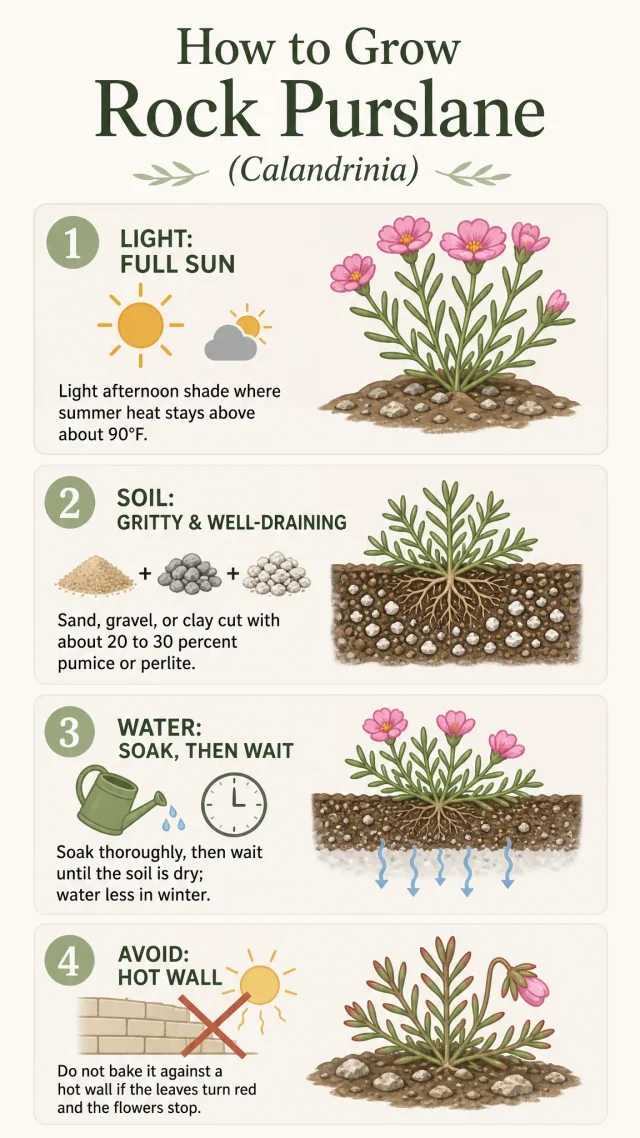
Give it full sun and soil that drains, and water only when it is dry
| Factor | Recommended | Avoid |
|---|---|---|
| Light | Full sun; light afternoon shade where summer heat stays above about 90°F | Do not bake it against a hot wall if the leaves turn red and the flowers stop |
| Water | Soak thoroughly, then wait until the soil is dry; water less in winter | Do not keep the roots wet, and do not water on a calendar while the soil is still moist |
| Soil | Sand, gravel, or clay cut with about 20 to 30 percent pumice or perlite | Do not plant it in heavy, wet clay |
| Drought | Skip extra water once the clump is established | Do not treat a dry week as a reason to soak a soggy bed |
| Winter | Keep the soil nearly dry; cut the mound back in late winter | Do not leave it wet through a freeze |
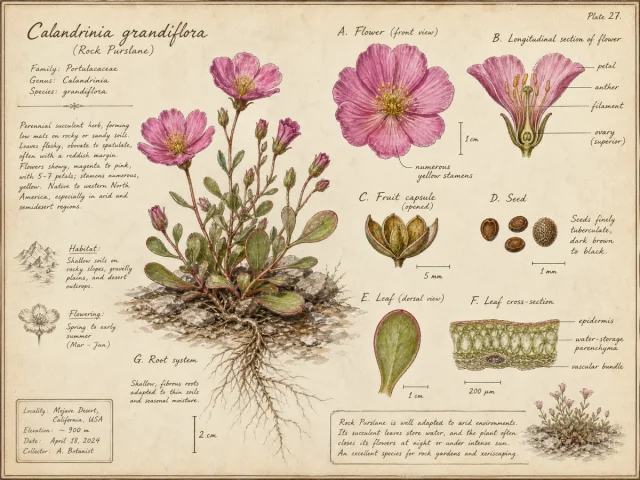
| Kind | Gray-green succulent mound with magenta flowers on tall thin stems | Do not buy needle-leaf moss rose or a daisy-flower ice plant and expect this plant |
rock purslane wants an open, bright bed and soil that dries between waterings. Soggy soil around the roots is the primary cause of root rot. [1] Inland, a little afternoon shade keeps the leaves from scorching when summer heat stays above about 90°F. [2] Magenta flowers last one day, but new buds open along the same stem. They stay closed in the morning, in the evening, and in wind, then open in sun. Wait until that whole stem is spent before you cut it.
- Set it in full sun. Add afternoon shade where summer heat stays brutal.
- Grow it in sand, gravel, or clay cut with pumice or perlite so water runs through.
- Soak the soil, then wait until it is dry before you water again. In winter, wait much longer.
How much sun does rock purslane need?
Full sun. Inland, give it light afternoon shade when summer heat stays above about 90°F, because harsh glare burns the leaves and the flowers stop.
How often should I water it?
Soak the soil, then wait until it is dry. Once the clump is established, skip extra water except in a long heat wave. Keep it nearly dry in winter.
Plant it in grit, with room to spread
Dig a hole about twice as wide as the nursery pot and backfill with a mix that includes pumice or perlite so water can leave. Set the crown at the same depth as it was already growing. Leave about 2 to 3 feet between plants, because the mound spreads. Water once to settle, then wait until the soil is dry. Stems snap if you grab them, so lift the pot, not the foliage.
- Choose a sunny, draining spot. Cut heavy clay with pumice or perlite.
- Dig a hole about twice the width of the nursery pot. Set the crown at the same depth as the pot.
- Space plants about 2 to 3 feet apart so the mound can fill in.
- Water once to settle the mix, then wait until the soil is dry before you water again.
How do I plant rock purslane?
Plant it in grit, at the same depth as the nursery pot, with about 2 to 3 feet of room. Water once to settle, then wait until the soil is dry.
Cut it back in late winter
Old leaves drop and the stems get long. In late winter, cut the mound back by about a third to a half of its height so new shoots fill in. When a flower stem has no buds left, cut it at the base of the foliage. Do not snip one flower at a time while buds are still opening on that stem.
- In late winter, cut long, bare stems back by about a third to a half of their height.
- When a flower stem is fully spent, cut it at the base of the foliage, not one bloom at a time.
- Root a healthy piece if you want another plant, or compost soft, mushy pieces.
When do I cut it back?
Cut the mound back in late winter, by about a third to a half. Wait until a flower stem is fully spent before you cut it at the base.
Cut a three-node stem, let it callus, then plant it
The usual way to make more rock purslane is a stem cutting, not seed. Take a firm stem with three or four nodes. Cut in the space between nodes so a short stump sits below the lowest node. Let the cut dry for a few days until it skins over, then push about a third of the stem into a mix that drains. [3] Roots usually form in two to four weeks. Keep the cutting in bright light, not hot midday sun, until a gentle tug meets resistance.
- Cut a firm stem with three or four nodes, in the space between nodes.
- Let the cut dry in the shade for a few days until it skins over.
- Push about a third of the stem into a mix of half potting mix and half pumice or perlite, in a pot with a hole.
- Keep it in bright light, not hot midday sun, until it resists a tug. Then water as you would the parent plant.
How do I start a new plant from a stem?
Cut a three-node stem, let the cut dry for a few days, then push it into mix that drains. Wait until it resists a tug before you water as usual.
Not moss rose — and not ice plant or common purslane
Moss rose is Portulaca, a low annual carpet with needle-like leaves and flowers that close at night. Rock purslane is a gray-green succulent mound with magenta flowers on tall thin stems. [4] See How to Grow Moss Rose if that is the plant you bought. Common purslane is the flat-leaf edible weed in the same family. It is not this ornamental mound.
Ice plant is Delosperma, a low daisy-flower mat. See How to Grow Ice Plant if the tag shows a tight carpet of daisy blooms. A tag that says Claytonia or spring beauty is a moist woodland plant — see How to Grow Spring Beauty.
Is this moss rose or common purslane?
No. Moss rose is a low annual with needle leaves. Common purslane is the flat-leaf edible weed. Rock purslane is a gray-green succulent mound with tall magenta stems.
Is this ice plant?
No. Ice plant is a low daisy-flower mat. Rock purslane holds its magenta flowers on tall thin stems above a gray-green mound.
Set it in full sun and grit, water only when the soil is dry, and root extras from a three-node stem.
FAQ
Is Jazz Time a different plant?
Jazz Time is a nursery selection of the same magenta succulent. Tags also say Calandrinia spectabilis or Cistanthe grandiflora. Give it the same sun, drain, and dry-between watering.
Can I grow it in a pot?
You can, in a pot with a hole and mix that drains, but the roots want room. A wide trough works better than a small cup. It is happier in the ground once nights stay warm.
Can I grow it from seed?
You can, but most gardeners start a stem cutting. Seed is slow in the north. The new plants still need sun and soil that drains.
Can I leave it out all winter?
Only where a hard freeze does not sit on the bed. About 20°F can burn the leaves. In a colder winter, grow it as an annual, or root a cutting under cover and plant after frost.
Can I eat it?
No. Common purslane is the salad weed. Rock purslane is an ornamental succulent. Do not copy a purslane recipe onto this plant.
Will pets chew it?
Keep pets from chewing any succulent. A chewed leaf can upset a stomach. This is not a food plant.
Recommended plants
References
- [1] Debra Lee Baldwin -
https://debraleebaldwin.com/succulent-plants/calandrinia-cistanthe-purslane/ - [2] UCANR Fresno Gardening Green -
https://ucanr.edu/blog/fresno-gardening-green/article/april-plant-month-calandrinia - [3] Greenhouse Studio -
https://www.greenhousestudio.co/home-garden/succulent-cistanthe-grandiflora - [4] San Marcos Growers -
https://www.smgrowers.com/products/plants/plantdisplay.asp?plant_id=2922
More first-season notes by plant are gathered in How to Grow Guides.
Updated: Reviewed by Bosquelle Editors