
Choose Taxodium by needles and cold: bald cypress, pond cypress, Nutans, or Montezuma cypress. We list four kinds.
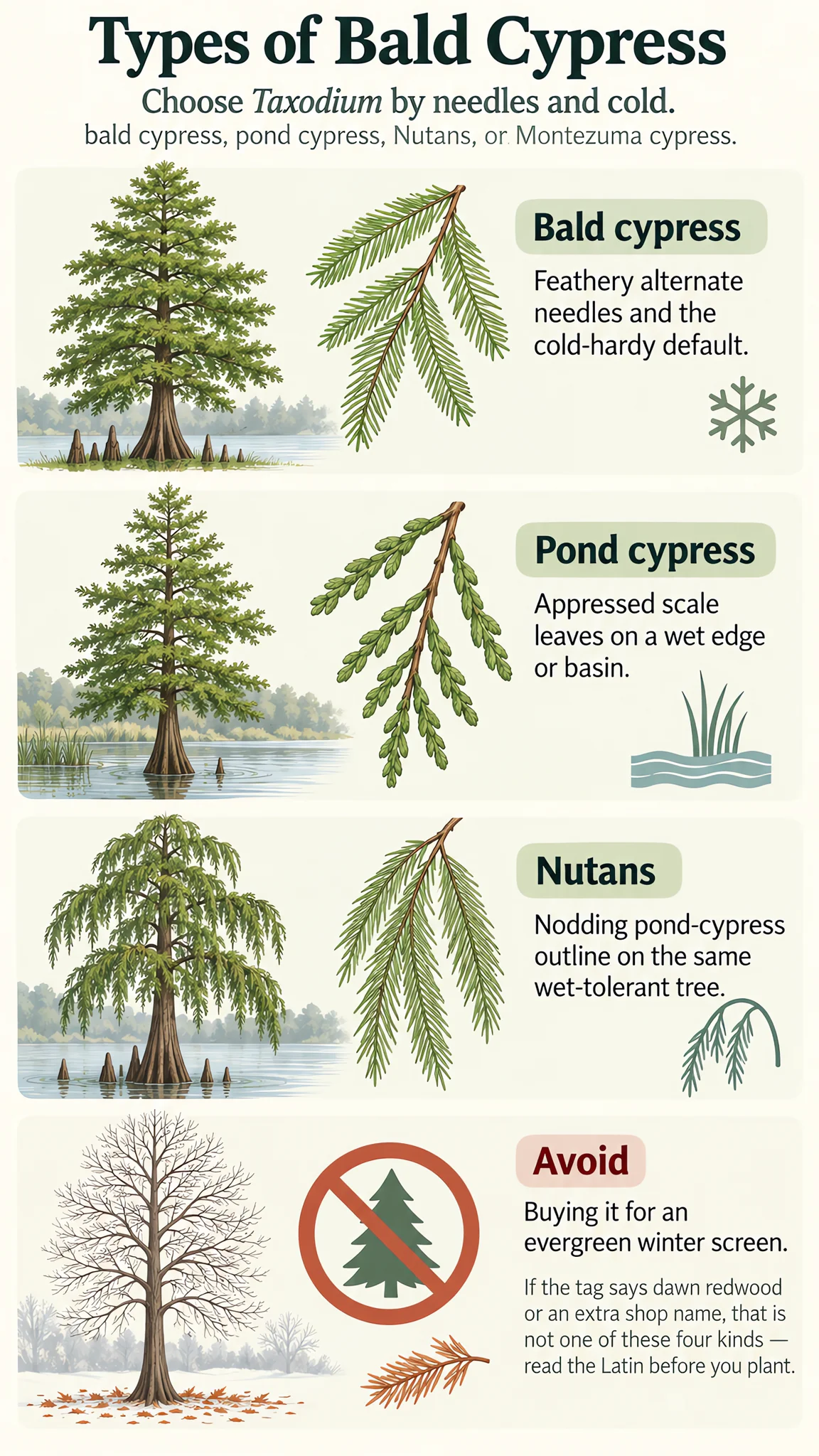
Choose bald cypress, pond cypress, Nutans, or Montezuma cypress
| Factor | Recommended | Avoid |
|---|---|---|
| Bald cypress | Feathery alternate needles and the cold-hardy default | Buying it for an evergreen winter screen |
| Pond cypress | Appressed scale leaves on a wet edge or basin | Assuming it is a different watering religion |
| Nutans | Nodding pond-cypress outline on the same wet-tolerant tree | Treating a cultivar name as a fifth species |
| Montezuma cypress | Warmer sites; often semi-evergreen | Northern winters equal to bald cypress |
Know your USDA hardiness zone before you pick a type of taxodium that will take your winter. Type your ZIP below.
2023 USDA ZIP listings (PRISM / USDA-ARS). Find Your USDA Hardiness Zone · Official USDA map.
Read the needles. The four we list are T. distichum, T. ascendens, T. distichum var. imbricarium ‘Nutans’, and T. mucronatum. [1] Culture is the same full sun and acid ground. Cold and leaf habit are the choice. [2]
Are bald cypress and swamp cypress the same?
Swamp cypress is a common name for bald cypress. Pond cypress is the kind with appressed leaves. Both are Taxodium.
How big do pond cypress get?
Still a large tree — often shorter and narrower than classic bald cypress, but not a patio shrub. Plan tens of feet, not a hedge.
Browse by kind
Bald cypress
T. distichum is the eastern landscape default: feathery alternate needles, winter bald, and the best cold story in this genus.
Pond cypress
T. ascendens holds shorter, appressed scale leaves and a narrower wet-edge habit. Knees, when they form, tend to be more rounded. Cold can be a little less than classic bald cypress.
Nutans
T. distichum var. imbricarium ‘Nutans’ is a pond-cypress selection with short horizontal branches and drooping branchlets — the same wet-tolerant Taxodium habits in a softer outline.
Montezuma cypress
T. mucronatum is Montezuma cypress — often semi-evergreen, faster in good heat, and not a match for northern bald-cypress winters.
All four share deciduous or semi-evergreen Taxodium habits: sun, acid soil, and a large taproot. Pick Montezuma only where winters stay mild. [3]
Not dawn redwood — and not extra shop names
Dawn redwood is Metasequoia: opposite leaflets, a different trunk, and typically no knees. Both drop needles in winter, which is why tags get swapped. [4] Coast redwood and giant sequoia stay evergreen. Extra nursery names such as Cascade Falls, Peve Minaret, and Shawnee Brave are still bald cypress habits — not extra kinds in this list.
Bald cypress vs dawn redwood — what’s the difference?
Bald cypress has alternate needles and can form knees in wet ground. Dawn redwood has opposite leaflets and is a different genus.
If the tag says dawn redwood or an extra shop name, that is not one of these four kinds — read the Latin before you plant.
FAQ
Do we list extra shop names as extra kinds?
No. We list four: bald cypress, pond cypress, Nutans, and Montezuma cypress. Extra nursery names use the same sun and acid ground.
Is Nutans a different species?
No. Nutans is a pond-cypress selection (var. imbricarium). Same genus, nodding outline.
Is Mexican cypress a different plant?
Mexican swamp cypress and sabino are catalog names for Montezuma cypress, Taxodium mucronatum.
What is another name for pond cypress?
Pond cypress is Taxodium ascendens, also treated as T. distichum var. imbricarium. Bald cypress is the feathery-needle default.
Related guides


References
- [1] NC State Extension -
https://plants.ces.ncsu.edu/plants/taxodium-distichum-var-imbricarium/ - [2] NC State Extension -
https://plants.ces.ncsu.edu/plants/taxodium-mucronatum/ - [3] Lady Bird Johnson Wildflower Center -
https://www.wildflower.org/plants/result.php?id_plant=TAMU - [4] Ohio State University Extension -
https://bygl.osu.edu/node/1730
This note is part of Taxodium Guides.
More type comparisons by plant are gathered in Types of Plants Guides.
Updated: Reviewed by Bosquelle Editors